Net-building Caddisflies and their Silk
Some caddisfly species build nets of silk, which can filter large amounts of water.
Find out more here:
Caddisfly larvae produce silk in large glands. Some species use this silk to build protective cases out of various materials. Other species use their silk to make nets with which they filter nutrients from the water or catch larger prey. These nets also serve to anchor the larvae in fast-flowing water.
Net-building caddisflies are often referred to as engineers of freshwater ecosystems. By building their nets, they create refuges for other aquatic life and stabilize the riverbed. In turn, they influence the water flow and help other species to inhabit the ecosystem. In this way, they contribute to biodiversity and help to keep freshwater habitats healthy.
Their silk serves as a model for promising applications in the fields of materials science and engineering, textile production and medicine. For example, the silk produced by caddisfly larvae sticks to objects under water, unlike that of their relatives, the butterflies.
Filter nets
Some silk constructions of caddisfly larvae resemble fine-meshed fishing nets (Figure 1a).
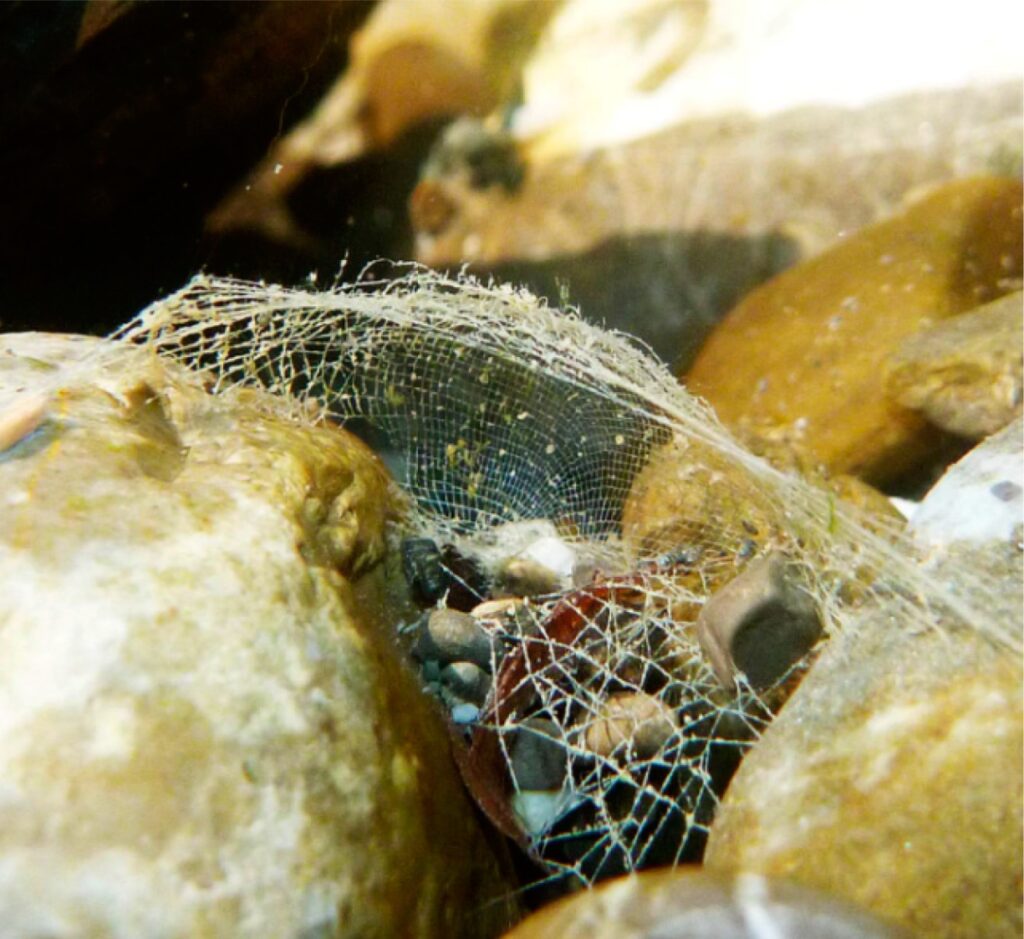
Figure 1a
Filter net and gravel retreat of Hydropsyche sp. (Hydropsychidae) between large stones © W. Graf
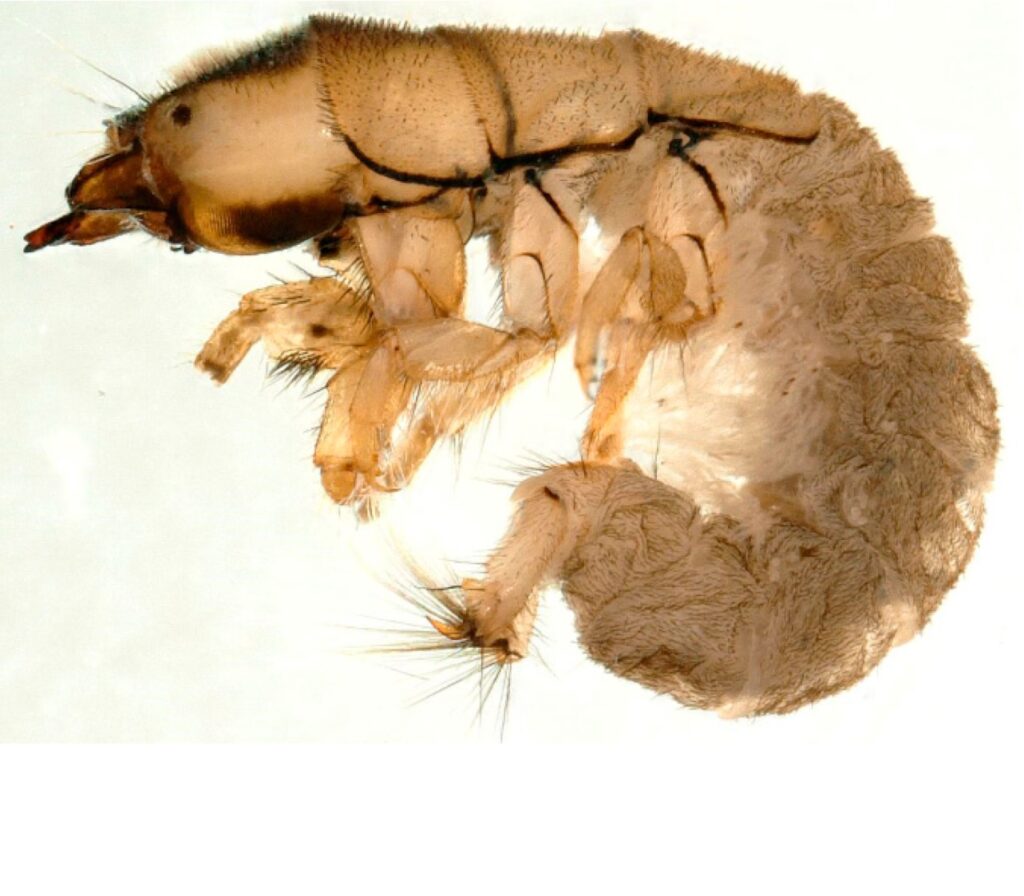
Figure 1b
Larva of Hydropsyche bulgaromanorum Malicky, 1977 (Hydropsychidae)
© W. Graf
Caddisfly larvae use their filter nets to strain suspended nutrients out of the water, e.g. fine food particles such as algae or microorganisms. In doing so, they play an important role in the ecosystem: they absorb nutrients and convert them so that they are also available to other freshwater organisms. A Hydropsyche siltalai net is capable of filtering 492 liters of water per day!
In addition, the areas directly behind the nets – where the water flows more slowly – offer other small aquatic animals a safe place where they are not in danger of being washed away.
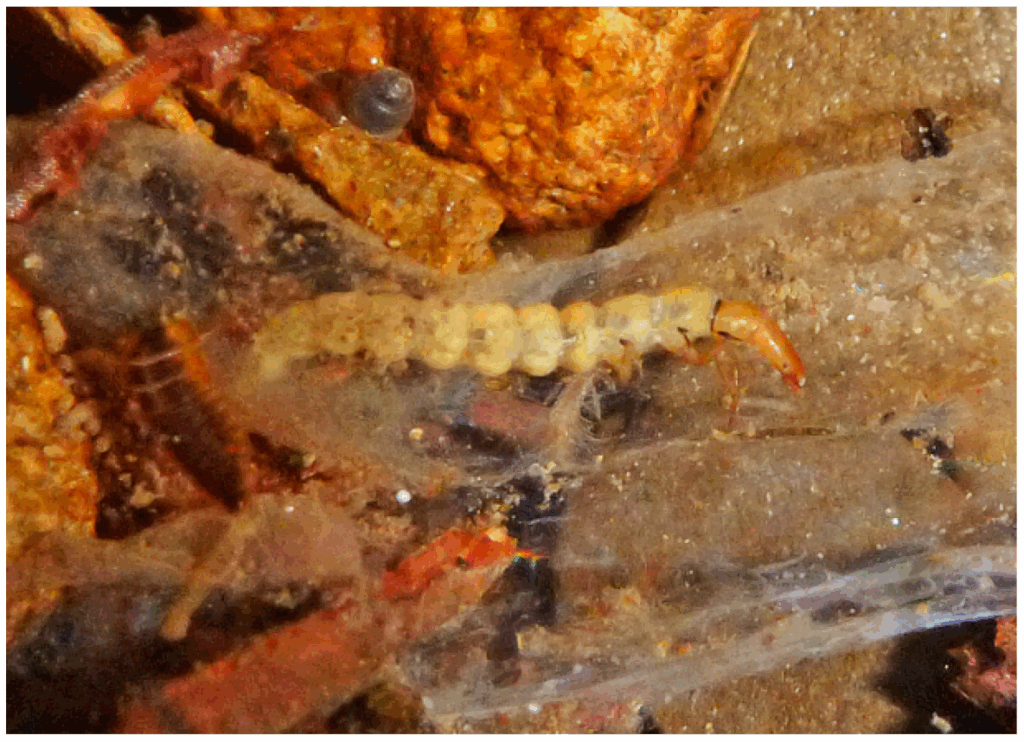
Figure 2
Larva of Wormaldia sp. (Philopotamidae) in its filter net
© W. Graf.
Larvae from the caddisfly family Philopotamidae build fine nets in slow-flowing parts of streams, usually under rocks (Figure 2). These nets have very small openings to catch fine food particles from the water. Unlike some other caddisflies, Philopotamid larvae do not build a separate shelter, but live inside the net itself. It is shaped like a small sack or finger. The front of the net is attached to the stream bed, often with small stones around the entrance to keep it open. The rest of the net floats freely in the gentle current, with a smaller opening at the back through which the water flows.
Capture Nets
Capture nets differ from filter nets in their coarser mesh size, their function in actively catching larger prey and their use by predatory caddisfly larvae. In contrast to filter nets, capture nets are not used to filter suspended matter, but to catch larger prey such as small crustaceans or insect larvae.
Predatory caddisfly larvae such as those of the genera Neureclipsis and Polycentropus build trumpet-shaped nets with a large opening facing the current (Figure 3). The larvae attach the front part of the net to fixed structures such as aquatic plants, submerged tree roots or branches. The unattached middle part of the net can move freely in the current, so that the water is directed into the net through the wide opening and can flow out again through the back, free of the prey and food particles.
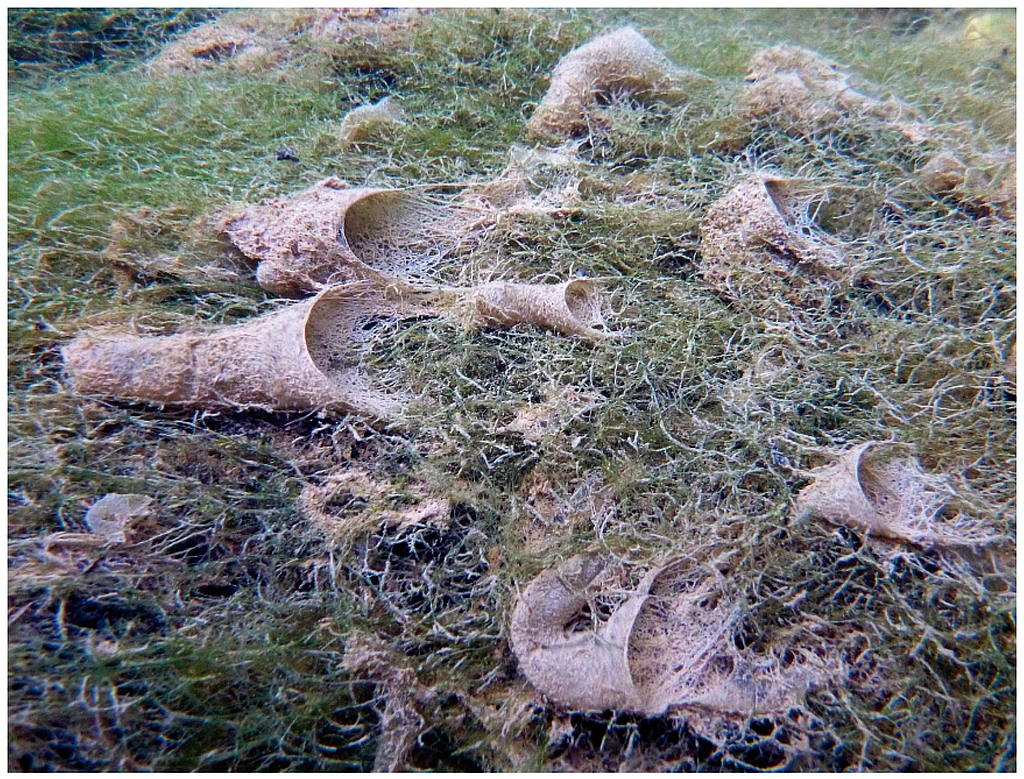
Figure 3
Capture nets of Neureclipsis sp. (Polycentropodidae)
© W. Graf.
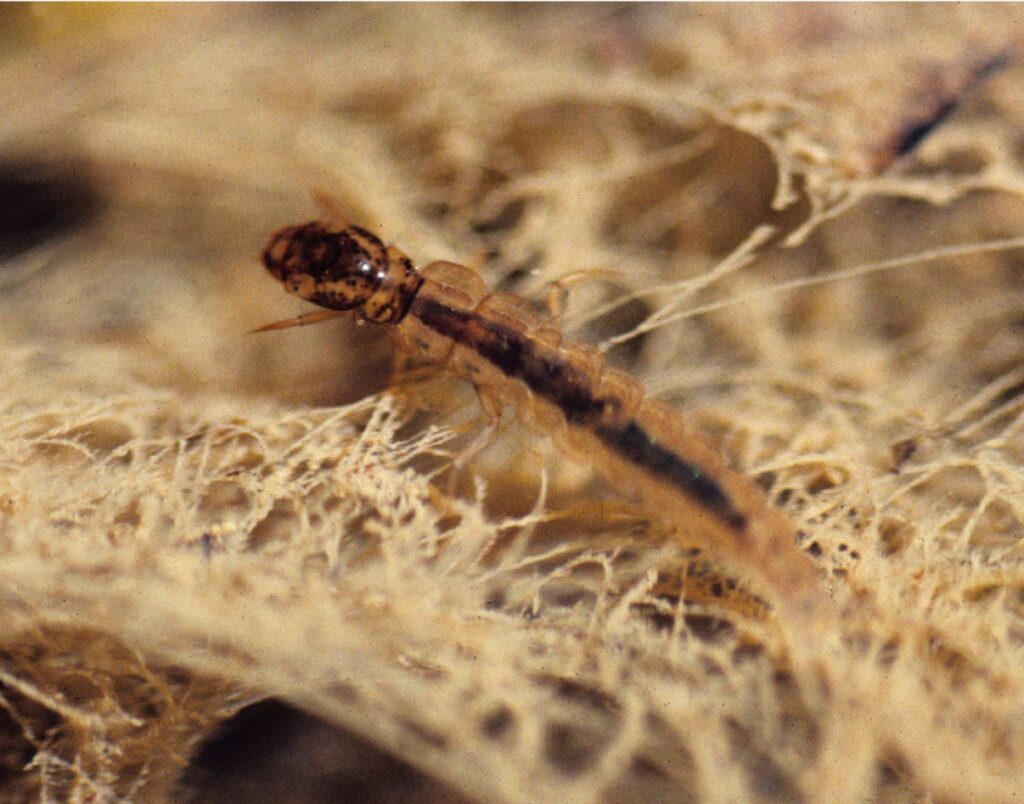
Figure 4a
Larva of Plectrocnemia conspersa (Curtis, 1834) (Polycentropodidae)
© W. Graf.
Other nets (Figure 4 a,b) function similarly to land-dwelling spider webs and are used both for catching prey and as protection from predators. They are equipped with silken trip lines that warn the larvae of potential intruders on the one hand and enable them to ambush unsuspecting prey on the other.
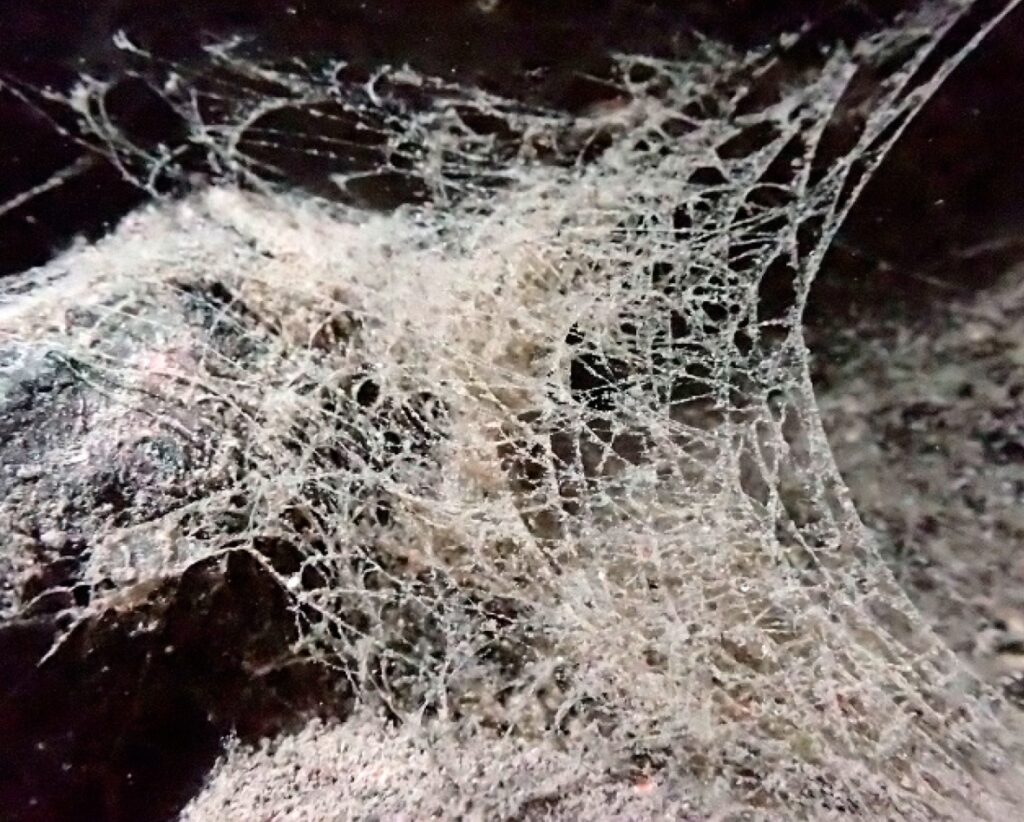
Figure 4b Capture net of P. conspersa
© W. Graf
Photos and text adapted from the following publication with permission:
Morse JC, Frandsen PB, Graf W, Thomas JA. Diversity and Ecosystem Services of Trichoptera. Insects. 2019 May 1;10(5):125.
doi: 10.3390/insects10050125. PMID: 31052441; PMCID: PMC6572163.